
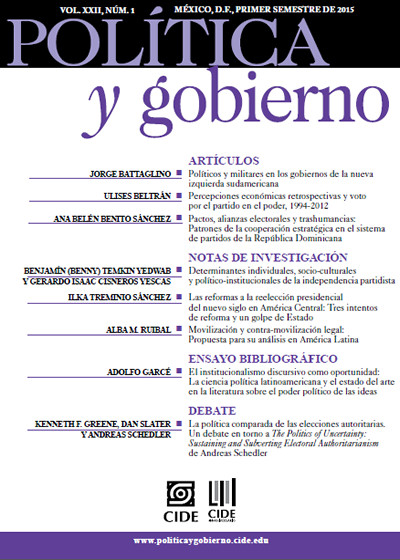
Pacts, Electoral Alliances and Party Shifting: Models of Strategic Cooperation in the Dominican Party System
Keywords:
pacts, alliances, party shifting, particularistic politics, Dominican RepublicAbstract
How do dominican political parties negotiate and what do they exchange? Analyzing the political agreements, electoral alliances and party shifting in Dominican Republic, this article presents a model of strategic cooperation, his types of interaction based on the principal actors (elites, parties or candidates), in a dual orientation (particularistic versus universalistic) determined by incentives and associate costs. The Dominican experience shows that the negotiate skills not always are used in the name of democratic governance, but reinforce the perverse institutionalization process.References
Abranches, S.H. (1988), “Presidencialismo de coalizao. O dilema institucional brasileiro”, Dados. Revista de Ciencias Sociais, 31(1), pp. 5-34.
Altman, D. (2000), “Coalition Formation and Survival Under Multiparty Presidential Democracies in Latin America: Between the Tirany of Electoral Calendar, the Irony of Ideological Polarization and Inertial Effects”, Latin American Studies Association Congress, Miami, 16-18 de marzo.
Amorin, O. (1998), “Cabinet Formation in Presidential Regimes: An Analysis of Ten Latin American Countries”, Latin American Studies Association Congress, Chicago.
(2002), “Presidential Cabinets, Electoral Cycles and Coalition Discipline in Brazil”, en S. Morgenstern y B. Nacif (eds.), Legislative Politics in Latin America, Nueva York, Cambridge University Press.
(2006), Presidencialismo e gobernabilidades nas Americas, Río de Janeiro, fgv/Konrad Adenauer Stiffung.
Axelrod, R. (1970), Conflict of Interest. A Theory of Divergent Goals with Applications to Politics, Chicago, Markham.
Benito Sánchez, A.B. (2010), “La política del poder: alianzas e interacciones partidistas estratégicas en República Dominicana”, Revista de Ciencia Política, 30(3), pp. 751-772.
(2011), “La marea morada: elecciones congresuales y municipales de 2010 en la República Dominicana”, en M. Alcántara y M.L. Tagina(eds.), América Latina: Política y Elecciones en el Bicentenario (2009-2010), Madrid, Centro de Estudios Políticos y Constitucionales, pp. 379-411.
Benito Sánchez, A.B. y R. Toribio (2013), “Hegemonía de un líder y de un partido: Las elecciones de 2010 y 2012 en República Dominicana”, en M. Alcántara y M.L. Tagina (coords.), Procesos políticos electorales en América Latina (2010-2013), Argentina, Eudeba, pp. 281-315.
Castellano, P. (1994), “Tránsfugas, trashumantes y travestis”, Diario 16, 9 de enero.
Chasquetti, D. (1999), “Compartiendo el gobierno: multipartidismo y coaliciones en el Uruguay (1971-1997)”, Revista Uruguaya de Ciencia Política, 10.
(2001), “Democracia, multipartidismo y coaliciones en América Latina: evaluando la difícil combinación”, en J. Lanzaro (ed.), Tipos de presidencialismo y modos de gobierno en América Latina, Buenos Aires, clacso.
Cheibub, A., A. Przeworki y S. Saiegh (2004), “Government Coalitions and Legislative Success under Presidentialism and Parliamentarism”, British
Journal of Political Science, 34, pp. 565-587.
Downloads
Issue
Section
License
The authors who publish in this journal agree on the following conditions:
In accordance with copyright laws, Política y gobierno recognizes and respects the authors’ moral rights, as well as the ownership of property rights, which will be transferred to the journal for its dissemination in open access. Política y gobierno does not charge the authors for submitting and processing articles for publication.
All the articles published in Política y gobierno —with no exception— are distributed under a Creative Commons License 4.0 Attribution Non-Commercial (CC BY-NC 4.0 International), that allows third parties to use the published work providing they mention the authorship of the work and the first publication in this journal.
The authors can enter into other independent and additional contractual arrangements for the non-exclusive distribution of the version of the article published in Política y gobierno (for example to include it into an institutional repository or publish it in a book) as lomg as it is clearly indicated that the work was published for the first time in Política y gobierno.
For all of the above, the author(s) must submit the Format of transfer of the ownership of the first publishing rights duly filled in and signed by the author(s). This format can be sent as a pdf by e-mail: politicaygobierno@cide.edu (Letter- transfer of property rights)

This work is licensed under a Creative Commons Attribution-Noncommercial 4.0 International.






 Contact