
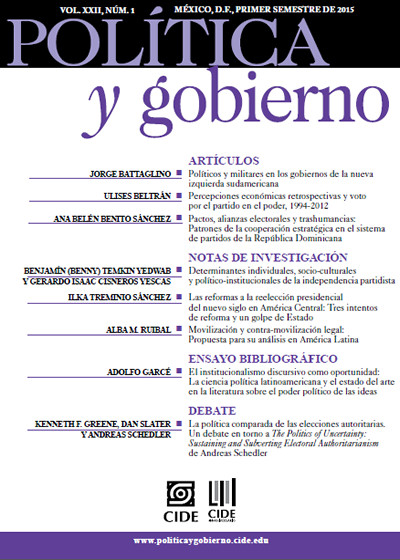
Central American Presidential Re-election Reforms in the New Century: Three Attempted Reforms and a Coup D’état
Keywords:
re-election, executive power, political institutions, constitutional amendments, Central AmericaAbstract
Central American countries entered the new century seeking to change the rules governing presidential re-election. All of the attempts studied have sought to relax the presidential term limits. In accordance with this behavior, this study seeks to understand the conditions that led to the success of presidential reform. For this purpose, we have developed a comparative qualitative analysis method that aims to determine the circumstances that shaped the experiences of those leaders who took steps towards achieving re-election modification.References
Ajenjo Fresno, N. (2007), “Honduras: nuevo gobierno liberal con la misma agenda política”, Revista de Ciencia Política, 27 (esp.), pp.165-181.
Alcántara Sáez, M. (2004), ¿Instituciones o máquinas ideológicas? Origen, programa y organización de los partidos latinoamericanos, Barcelona, icps.
Bacchetta, Víctor L. (1986), “El desmoronamiento político de un ejército. La Guardia Nacional somocista”, Nueva Sociedad, 81, pp. 19-35.
Bosch, A., A. Díaz y C. Riba (1999), “Las funciones de popularidad. Estado de la cuestión y principales debates”, Revista Española de Ciencia Política, 85, pp. 171-197.
Brewer Carías, A. (2009), “Reforma constitucional, Asamblea Nacional Constituyente y control judicial contencioso administrativo. El caso de Honduras (2009) y el antecedente venezolano (1999)”, Estudios Constitucionales,7(2), pp. 317-353.
Bueno de Mesquita, B., S. Alastair, R.M. Siverson y J.D. Morrow (2003), The Logic of Political Survival, Cambridge, The mit Press.
Buquet, D. (2007), “Entre la legitimidad y la eficacia: Reformas en los sistemas de elección presidencial en América Latina”, Revista Uruguaya de Ciencia Política, 16(1), pp. 35-49.
Calvo, E. (2007), “The Responsive Legislature: Public Opinion and Law Making in a Highly Discipline Legislature”, British Journal of Political Science, 2(37), pp. 263-280.
Carey, J.M. (2003a), “Presidencialismo e Instituciones Representativas”, en J. Domínguez y M. Shifter, Construcción de gobernabilidad democrática en América Latina, México, Fondo de Cultura Económica.
(2003b), “The Reelection Debate in Latin America”, Latin American Politics and Society, 45(1), pp. 119-133.
Cheibub, J.A. (2007), Presidentialism, Parlamentarism, and Democracy, Cambridge, Cambridge University Press.
Cheibub, J.A., Z. Elkins, y T. Ginsburg (2011), “Latin American Presidentialism in Comparative and Historical Perspectives”, Texas Law Review, 89(1), pp. 1707-1939.
Cheresky, Isidoro (2006), “Elecciones en América Latina. Poder presidencial y liderazgo político bajo la presión de la movilización de la opinión pública y la ciudadanía”, Nueva Sociedad, 206.
Close, D. (2012), “Las reelecciones de Óscar Arias, Alan García y Daniel Ortega (2006), Tres comebacks políticos excepcionales”, Revista Uruguaya de Ciencia Política, 21(2), pp. 55-76.
Corrales, J. (2008), “Latin Americas’ Neocaudillism: Ex-Presidents and Newcomers Running for President… and Winning”, Latin American Politics and Society, 50(3), pp. 1-35.
Collier, D. (2011), “Understanding Process Tracing”, Political Science and Politics, 44(4), pp. 823-830.
Elkins, Z., T. Ginsburg y J. Melton (2009), Endurance National Constitutions, Cambridge, Cambridge University Press.
Ennser-Jedenastin, L. y W.C. Müller (2011), “Intra-party Democracy, Political Performance, and Survival of Party Leaders: Austria 1945-2011”, Documento de trabajo, University of Vienna, Department of Government.
Esgueva Gómez, A. (2005), “Contexto histórico de las constituciones y sus reformas en Nicaragua”, Revista de Derecho, 10, pp. 93-116
Gandásegui, M.A. (2010), “Panamá 2009: Elecciones, crisis mundial y movimientos sociales”, Revista de Ciencia Política, 30(2), pp. 419-437.
García Díez, F. (2001), “Reformas electorales y sistemas de partidos parlamentarios en América Central”, América Latina Hoy, 27, pp. 37-65
García Montero, M. (2009), Presidentes y parlamentos ¿Quién controla la actividad legislativa en América Latina?, Madrid, Centro de Investigaciones Sociológicas (cis).
Gargarella, R. (2010), “El nuevo constitucionalismo latinoamericano. Algunas reflexiones preliminares”, Crítica y Emancipación, 3, pp. 11-44.
(2012), 200 años de Constitucionalismo en América Latina, Buenos Aires.
Geddes, B. (1993), “The Initiation of New Democratic Institutions in Eastern Europe and Latin America”, Working Paper, Center for Institutional Reform and Informal Sector, University of Maryland.
(1994), Politician’s Dilemma. Building the State Capacity in Latin America, California, University of California Press.
Jones, M.P. (1995), Electoral Laws and the Survival of Presidential Democracies, Indiana, University of Notre Dame Press.
Le Duc, L. (2002), “Referendums and Initiatives: The Politics of Direct Democracy”, en L. Le Duc, R. Niemi y P. Norris, Comparing Democracies 2. New Challenges in the Study of Elections and Voting, Newbury Park, Sage.
Levitsky, S. y M.V. Murillo (2009), “Variation in Institutional Strength”, Annual Review of Political Science, 12, pp. 115-133.
Linz, J.J. (1987), La quiebra de las democracias, Madrid, Alianza.
(1990), “The Perils of Presidentialism”, Journal of Democracy, 1(1), pp. 51-69.
Lijphart, A. (1999), Patterns of Democracy. Government Forms and Performance in Thirty-Six Countries, Yale, Yale University Press.
Mainwaring, Scott y Shugart Matthew S. (1997), Presidentialism and Democracy in Latin America, Cambridge, Cambridge University Press.
Martí i Puig, S. (2008), “El regreso de Ortega: los primeros pasos de su segunda administración”, Revista de Ciencia Política, 28(1), pp. 287-303.
(2009), “Nicaragua 2008: polarización y pactos”, Revista de Ciencia Política, 29(2), pp. 515-531.
(2010), “The adaption of fsln: Daniel Ortega’s Leadership and Democracy in Nicaragua”, Latin America Politics and Society, 52(4), pp. 79-106.
(2013), “La consolidación de un régimen híbrido”, Revista de Ciencia Política, 33(1), pp. 269-286.
Martínez Barahona, E. (2010), “Las Cortes Supremas como mecanismos de distribución de poder: el caso de la reelección presidencial en Costa Rica y Nicaragua”, Revista de Ciencia Política, 30(3), pp. 723-750.
Martínez Barahona, E. y A. Brenes (2012), “ Y volver, volver, volver... Un análisis de los casos de intervención de las Cortes Supremas en la reelección presidencial en Centroamérica”, Anuario de Estudios Centroamericanos, 38, pp. 109-136.
McConnell, S.A. (2010), “The Return of Continuismo?” Current History Journal, 109(724), pp. 74-80.
Melton, J. (2012), “Constitutional Amendment Procedures: A Summary and Critique of Existing Measures”, presentación en Luiss Guido Carli University.
Meza, V. (2012), “Honduras: crisis política y solución democrática”, Documentos de Análisis. Boletín Especial, 97, pp. 3-33.
Meza, V., R. Romero, M. Gamero, L. Funes, L. Salomón y A. Murga (2010), Golpe de Estado: Partidos, instituciones y cultura política, Tegucigalpa, Christian Integral Development Organization in Honduras (cidoh).
Negretto, G. (2006), “Choosing How to Choose Presidents: Parties, Military Rulers and Presidential Elections in Latin America”, Journal of Politics, 68(2), pp. 421-433.
(2009), “Paradojas de la reforma constitucional en América Latina”, Journal of Democracy en Español, 1(1), pp. 38-54.
(2011), “Shifting Constitutional Design in Latin America. A Two Level Explanation”, Texas Law Journal, 89(7), pp. 1777-1806.
Nohlen, D. (1991), “Presidencialismo, sistemas electorales y sistemas de partidos. Reflexiones exploratorias para América Latina”, en D. Nohlen y M. Fernández, Presidencialismo vs. parlamentarismo, Caracas, Nueva Sociedad, pp. 51-70.
(2005), Elections in the Americas. A Database Handbook, vols. I y II, Oxford, Oxford University Press.
Nolte, D. y A. Schiling-Vacaflor (2012), New Constitutionalism in Latin America. Promises and Practices, Londres, Ashgate.
Pérez Liñán, A. (2008), “Instituciones, coaliciones callejeras e inestabilidad política: Perspectivas teóricas sobre las crisis presidenciales”, América Latina Hoy, 49, pp. 105-126.
Pérez Liñán, A. y A. Castagnola (2009), “Presidential Control of Courts in Latin America: A Longterm View (1904-2006)”, Journal of Politics in Latin America, 1(2), pp. 87-114.
Ragin, Charles C. (1987), The Comparative Method. Moving Beyond Qualitative and Quantitative Strategies, California, University of Californa Press.
Rihoux, B. y G. De Meur (2009), “Crisp-Set Qualitative Comparative Analysis”, en B. Rihoux y C. Ragin, Configurational Compartives Methods. Qualitative Comparative Analysis (qca) and Related Techniques, Newbury Park, Sage.
Samuels, D.y M. Shugart (2006), “Presidents, Prime Ministers, and Parties a Neo-Madisonian Theory of Party Organization and Behaviour”, Meeting of the American Political Science Association, Filadelfia, pp. 2-36.
Samuels, D. y M. Shugart (2011), “Presidentes, partidos y relaciones ejecutivo-legislativo”, en M. Alcántara Sáez y M.García Montero, Algo más que presidentes. El papel del Poder Legislativo en América Latina, Zaragoza, Fundación Manuel Giménez Abad.
Sánchez Ancoechea, D. y S. Martí Puig (eds.) (2014), Handbook of Central American Governance, Nueva York, Routledge.
Serrafero, M. (2009), “Reelección presidencial en América Latina: Evolución y situación actual”, Boletín de Política Comparada, 2(2), pp. 24-43
(2011), “La reelección presidencial indefinida en América Latina”, Revista de Instituciones, Ideas y Mercados, 54, pp. 225-259.
Strom, K. (1990), “A Behavioral Theory of Competitive Political Parties”, American Journal of Political Science, 32(2), pp. 565-598.
Strom, K. y W. Müller (1999), Policy, Office or Votes? How Political Parties in Western Europe Make Hard Decisions, Cambridge, Cambridge University Press.
Taylor-Robinson, M. (2009), “Honduras: Una mezcla de cambio y continuidad”, Revista de Ciencia Política, 29(2), pp. 471-489.
Taylor Robinson, M. y J.D. Ura (2012), “Public Opinion and Conflict in the Separation of Powers: Understanding the Honduras Coup of 2009”, Journalof Theoretical Politics, 25(1), pp. 1-23.
Tsebelis, G. (2006), Jugadores con veto. Cómo funcionan las instituciones políticas, México, Fondo de Cultura Económica.
Weyland, K. (2011), “Cambio institucional en América Latina: Modelos externos y consecuencias no previstas”, América Latina Hoy, 57, pp. 117-143.
Zelaya, R. M. (2010), La reelección presidencial: Un estudio comparativo de casos en América Latina, Managua, Instituto Republicano Internacional.
Zovatto, D. (2005), “La reforma político electoral en América Latina. Evolución, situación actual y tendencias 1978-2005”, Elecciones, 5, pp. 75-104.
Downloads
Issue
Section
License
The authors who publish in this journal agree on the following conditions:
In accordance with copyright laws, Política y gobierno recognizes and respects the authors’ moral rights, as well as the ownership of property rights, which will be transferred to the journal for its dissemination in open access. Política y gobierno does not charge the authors for submitting and processing articles for publication.
All the articles published in Política y gobierno —with no exception— are distributed under a Creative Commons License 4.0 Attribution Non-Commercial (CC BY-NC 4.0 International), that allows third parties to use the published work providing they mention the authorship of the work and the first publication in this journal.
The authors can enter into other independent and additional contractual arrangements for the non-exclusive distribution of the version of the article published in Política y gobierno (for example to include it into an institutional repository or publish it in a book) as lomg as it is clearly indicated that the work was published for the first time in Política y gobierno.
For all of the above, the author(s) must submit the Format of transfer of the ownership of the first publishing rights duly filled in and signed by the author(s). This format can be sent as a pdf by e-mail: politicaygobierno@cide.edu (Letter- transfer of property rights)

This work is licensed under a Creative Commons Attribution-Noncommercial 4.0 International.






 Contact