
Votes and voters in the federal election of 2006
Keywords:
Mexico, presidential election, legislative election, political conductAbstract
The presidential election of 2006 has been the most competitive in the mexican electoral history and the explanations for this are not yet clear. Making use of exit polls, this work presents a systematic analysis of the socio-economic, cultural and political preferences built around the election, as well as that of the Congress. It was found that Felipe Calderón was more popular among young people and women, especially among the higher education and higher earnings. On the other hand, Andrés Manuel López Obrador was more successful among old adults with low incomes, fighting against Roberto Madrazo from the vote of the poorest sectors. The results underscore the importance of the variable of presidential approval in the prediction of the vote. We would like to stress that the reviews of the economy staff do not have a statistically significant effect on the decision of the voters. ART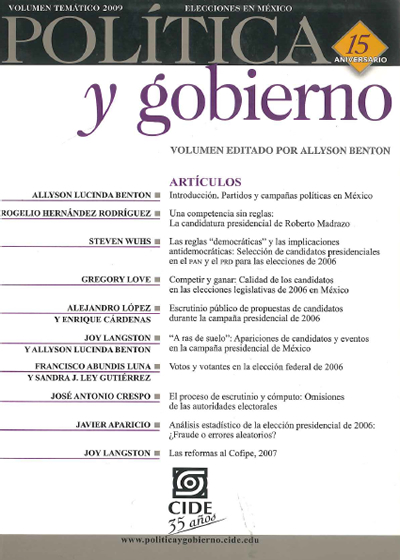
Downloads
Issue
Section
License
The authors who publish in this journal agree on the following conditions:
In accordance with copyright laws, Política y gobierno recognizes and respects the authors’ moral rights, as well as the ownership of property rights, which will be transferred to the journal for its dissemination in open access. Política y gobierno does not charge the authors for submitting and processing articles for publication.
All the articles published in Política y gobierno —with no exception— are distributed under a Creative Commons License 4.0 Attribution Non-Commercial (CC BY-NC 4.0 International), that allows third parties to use the published work providing they mention the authorship of the work and the first publication in this journal.
The authors can enter into other independent and additional contractual arrangements for the non-exclusive distribution of the version of the article published in Política y gobierno (for example to include it into an institutional repository or publish it in a book) as lomg as it is clearly indicated that the work was published for the first time in Política y gobierno.
For all of the above, the author(s) must submit the Format of transfer of the ownership of the first publishing rights duly filled in and signed by the author(s). This format can be sent as a pdf by e-mail: politicaygobierno@cide.edu (Letter- transfer of property rights)

This work is licensed under a Creative Commons Attribution-Noncommercial 4.0 International.






 Contact