
Party Identification in the 2000 and 2006 Presidential Elections in Mexico
Keywords:
cross-over voting, split-ticket voting, partisan vote, party identification, realignment, dealignment, Mexican electionsAbstract
In this article, we analyze the patterns of change in party identification observed in the2000 and 2006 presidential elections in Mexico. Based primarily on national exit poll data, we focuson three observed and interrelated phenomena: first, there was a slight decline in the level of partisanshipobserved not only among voters who turned out, but also among the electorate at large. Secondly,party identification remains one of the most important explanatory variables of the vote inMexico, but partisan voting was slightly weaker in 2006, as evidenced by the levels of cross-overvoting and split-ticket voting in each election. Finally, a multivariate analysis based on these datashows significant changes in the social and ideological composition of party identification, providingevidence of how partisan realignment among segments of the Mexican electorate is taking place.From 2000 to 2006, formerly strong PRI identifiers, such as women and rural voters, adopted identificationwith either PAN or PRD. Our analysis also documents transformations such as leftist PAN voterschanging to PRD and highly educated voters becoming increasingly independent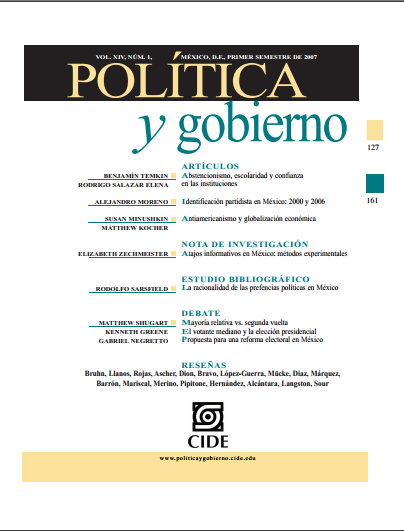
Downloads
Issue
Section
License
The authors who publish in this journal agree on the following conditions:
In accordance with copyright laws, Política y gobierno recognizes and respects the authors’ moral rights, as well as the ownership of property rights, which will be transferred to the journal for its dissemination in open access. Política y gobierno does not charge the authors for submitting and processing articles for publication.
All the articles published in Política y gobierno —with no exception— are distributed under a Creative Commons License 4.0 Attribution Non-Commercial (CC BY-NC 4.0 International), that allows third parties to use the published work providing they mention the authorship of the work and the first publication in this journal.
The authors can enter into other independent and additional contractual arrangements for the non-exclusive distribution of the version of the article published in Política y gobierno (for example to include it into an institutional repository or publish it in a book) as lomg as it is clearly indicated that the work was published for the first time in Política y gobierno.
For all of the above, the author(s) must submit the Format of transfer of the ownership of the first publishing rights duly filled in and signed by the author(s). This format can be sent as a pdf by e-mail: politicaygobierno@cide.edu (Letter- transfer of property rights)

This work is licensed under a Creative Commons Attribution-Noncommercial 4.0 International.






 Contact