
Popular Sovereignty, Democracy and the Constituent Power
Keywords:
sovereignty, constituent power, democracy, legitimacy, normativityAbstract
The concept of sovereignty is today seriously challenged. Contemporary critics of sovereigntyhave focused on its hierarchical, unitary, discretionary, and arbitrary attributes.Hence, sovereign power is treated as anachronistic and dangerous, the cause of the manywrongs that have marked modern politics. This paper seeks to defend the notion and practiceof sovereignty as inherently democratic. The argument begins with and relies on thehistorical observation that the idea of sovereignty as supreme command corresponds tomerely one definition among several to be proposed and acted on in the long history ofthis term. An alternative definition can be traced to the writings of several modern politicaland constitutional thinkers, for whom sovereignty was understood not as the ultimatecoercive power of command but instead as the power to found, to posit, to constitute, thatis, as a constituting power. It is this alternative conceptualization of the sovereign as constituentpower that this article excavates and recovers as a more attractive and relevantform of popular sovereignty, more attuned to the emancipatory and egalitarian promisesof a normative theory of democracy.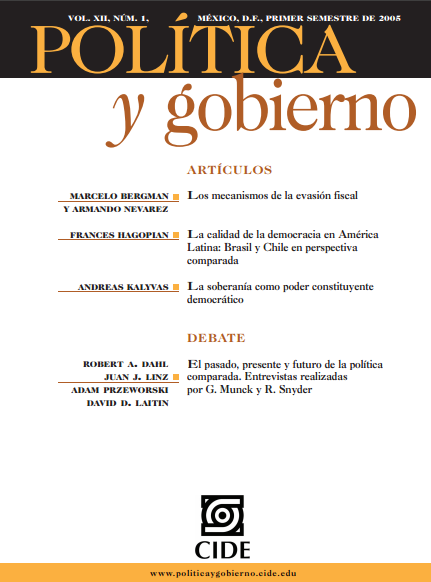
Downloads
Issue
Section
License
The authors who publish in this journal agree on the following conditions:
In accordance with copyright laws, Política y gobierno recognizes and respects the authors’ moral rights, as well as the ownership of property rights, which will be transferred to the journal for its dissemination in open access. Política y gobierno does not charge the authors for submitting and processing articles for publication.
All the articles published in Política y gobierno —with no exception— are distributed under a Creative Commons License 4.0 Attribution Non-Commercial (CC BY-NC 4.0 International), that allows third parties to use the published work providing they mention the authorship of the work and the first publication in this journal.
The authors can enter into other independent and additional contractual arrangements for the non-exclusive distribution of the version of the article published in Política y gobierno (for example to include it into an institutional repository or publish it in a book) as lomg as it is clearly indicated that the work was published for the first time in Política y gobierno.
For all of the above, the author(s) must submit the Format of transfer of the ownership of the first publishing rights duly filled in and signed by the author(s). This format can be sent as a pdf by e-mail: politicaygobierno@cide.edu (Letter- transfer of property rights)

This work is licensed under a Creative Commons Attribution-Noncommercial 4.0 International.






 Contact