
Explaining Turnout in a New Democracy: The 2000 Presidential Election in Mexico
Keywords:
political participation, electoral and political behavior, turnoutAbstract
Turnout in Mexico has two faces. On the one hand, citizens go to the polls for the samereasons as voters from established democracies do: individual resources and group attachmentsincrease their likelihood of voting. On the other, citizens are distrustful of voting asa result of many decades of fraudulent elections. Mexicans come to the polls with a set ofpolitical attitudes and behaviour learned under an authoritarian regime and this legacy influenceshow they evaluate and react to parties and elections. In this context, perceptionsof the political system have a larger than expected influence on turnout.Individuals who share the perception that parties and congressmen do not care aboutcitizens needs and who have negative evaluations about democracy and elections tend tovote less than those who have opposite views. Further, non-electoral modes of participationare negatively correlated with turnout, suggesting that abstention is a protest againsta traditionally ineffective political system such as the Mexican. One of the challenges ofMexicos democratic consolidation will be to modify these political attitudes which developedunder the ancien rgime, and that today play such an important role in leading peopleto the polls.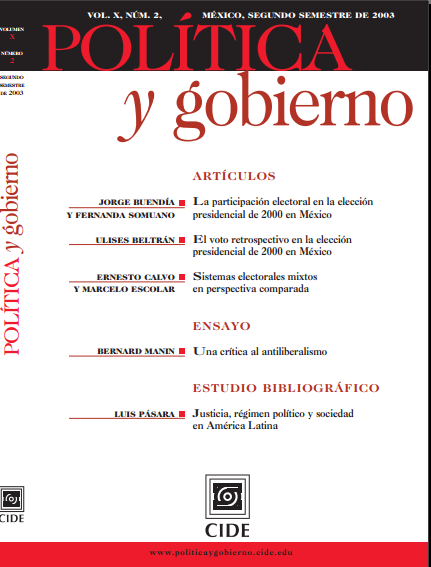
Downloads
Issue
Section
License
The authors who publish in this journal agree on the following conditions:
In accordance with copyright laws, Política y gobierno recognizes and respects the authors’ moral rights, as well as the ownership of property rights, which will be transferred to the journal for its dissemination in open access. Política y gobierno does not charge the authors for submitting and processing articles for publication.
All the articles published in Política y gobierno —with no exception— are distributed under a Creative Commons License 4.0 Attribution Non-Commercial (CC BY-NC 4.0 International), that allows third parties to use the published work providing they mention the authorship of the work and the first publication in this journal.
The authors can enter into other independent and additional contractual arrangements for the non-exclusive distribution of the version of the article published in Política y gobierno (for example to include it into an institutional repository or publish it in a book) as lomg as it is clearly indicated that the work was published for the first time in Política y gobierno.
For all of the above, the author(s) must submit the Format of transfer of the ownership of the first publishing rights duly filled in and signed by the author(s). This format can be sent as a pdf by e-mail: politicaygobierno@cide.edu (Letter- transfer of property rights)

This work is licensed under a Creative Commons Attribution-Noncommercial 4.0 International.






 Contact