
Territorial control and vote choice in Colombia A multilevel approach
Keywords:
territorial control, vote choice, Colombia, multilevel approachAbstract
This paper develops a theoretical framework for understanding the relationship between violent contexts of territorial control and vote choice by drawing on insights from literature on the contextual determinants of political behavior and civil wars. It tests the hypothesis that individuals living in a violent context tend to behave in line with the strategic objectives and ideological orientations proclaimed by the armed actor dominating the area. Using a national survey conducted in Colombia in 2005, and contextual level data, this paper employs hierarchical regression models to test this hypothesis. Results suggest that on moving from areas dominated by the colombian state to regions controlled by right-wing paramilitary groups, individuals were more likely to support a presidential candidate on the right of the ideological spectrum. However, this relationship appears to be conditioned by partisanship, as minority party sympathizers’ vote choices are the most affected by changes in violent contexts.References
Jones, Bobby, Daniel S. Nagin and Kathryn Roeder (2001), “A sas Procedure Based on Mixture models for Estimating Developmental Trajectories”, Sociological Methods and Research, 29(3), pp. 374-93.
Kalyvas, Stathis (2006), The Logic of Violence in Civil War, New York, Cambridge University Press.
Nagin, Daniel S. (2005), Group-Based Modeling of Development, Cambridge, Harvard University Press.
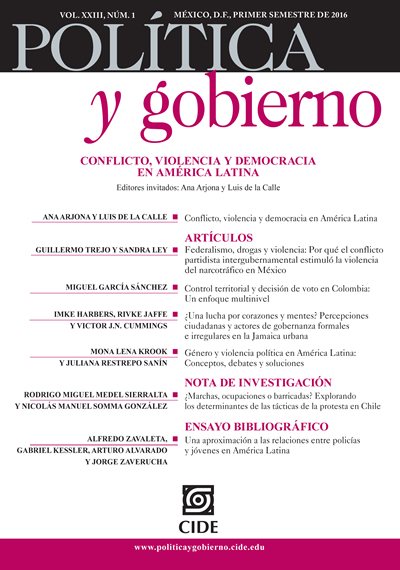
Issue
Section
License
The authors who publish in this journal agree on the following conditions:
In accordance with copyright laws, Política y gobierno recognizes and respects the authors’ moral rights, as well as the ownership of property rights, which will be transferred to the journal for its dissemination in open access. Política y gobierno does not charge the authors for submitting and processing articles for publication.
All the articles published in Política y gobierno —with no exception— are distributed under a Creative Commons License 4.0 Attribution Non-Commercial (CC BY-NC 4.0 International), that allows third parties to use the published work providing they mention the authorship of the work and the first publication in this journal.
The authors can enter into other independent and additional contractual arrangements for the non-exclusive distribution of the version of the article published in Política y gobierno (for example to include it into an institutional repository or publish it in a book) as lomg as it is clearly indicated that the work was published for the first time in Política y gobierno.
For all of the above, the author(s) must submit the Format of transfer of the ownership of the first publishing rights duly filled in and signed by the author(s). This format can be sent as a pdf by e-mail: politicaygobierno@cide.edu (Letter- transfer of property rights)

This work is licensed under a Creative Commons Attribution-Noncommercial 4.0 International.






 Contact