
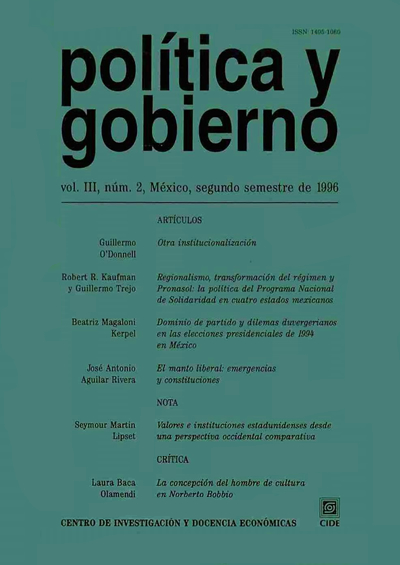
Dominio de partido y dilemas duvergerianos en las elecciones presidenciales de 1994 en México
Abstract
The paper analyses party dominance in México from a social choice perspective. It explores the coordination dilemmas opposition votes face by identifying various types of opposition votes using their complete preference orders among the three major parties, the PRI, the PAN and the PRD. It shows that there are opposition voters who would be willing to strategically vote for the opposition píirty that has the great-est chance of defeating the PRI; however, there are also opposition voters who would not be willing to put their ideological differences aside to defeat the PRI. Moreover, opposition parties possess a large proportion of "rigid" voters who possess weak preferences orders among the three parties and would only vote for their first preference. Henee, despite electoral rules and Duverger's Law, in México three parties survive and there is no tendency towards bipolarity in presidential elections, which in tum strengthens the PRI. The paper also explores, from a game theory perspective, the strategic reasona why the opposition parties have not attempted to coordinate their eíForts by nominating a common presidential candidato capable of seriously challenging the PRI's dominance in presidential elections.
Downloads
Published
Issue
Section
License
The authors who publish in this journal agree on the following conditions:
In accordance with copyright laws, Política y gobierno recognizes and respects the authors’ moral rights, as well as the ownership of property rights, which will be transferred to the journal for its dissemination in open access. Política y gobierno does not charge the authors for submitting and processing articles for publication.
All the articles published in Política y gobierno —with no exception— are distributed under a Creative Commons License 4.0 Attribution Non-Commercial (CC BY-NC 4.0 International), that allows third parties to use the published work providing they mention the authorship of the work and the first publication in this journal.
The authors can enter into other independent and additional contractual arrangements for the non-exclusive distribution of the version of the article published in Política y gobierno (for example to include it into an institutional repository or publish it in a book) as lomg as it is clearly indicated that the work was published for the first time in Política y gobierno.
For all of the above, the author(s) must submit the Format of transfer of the ownership of the first publishing rights duly filled in and signed by the author(s). This format can be sent as a pdf by e-mail: politicaygobierno@cide.edu (Letter- transfer of property rights)

This work is licensed under a Creative Commons Attribution-Noncommercial 4.0 International.






 Contact