
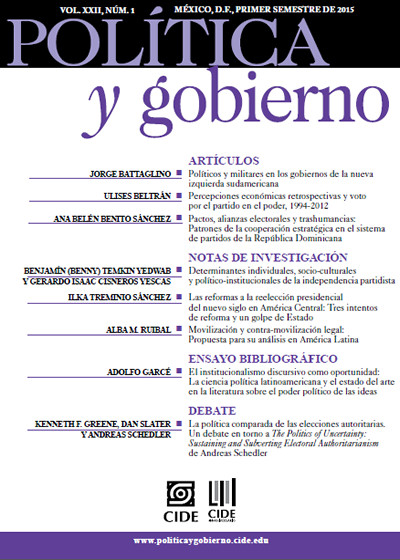
Individual, Socio-cultural and Political-institutional Determinants of the Partisan Independence
Keywords:
partisan independence, partisan identification, government performance, modernization, party competition, effective number of parties, post-materialismAbstract
The determinant factors of partisan independence are analyzed using the case of Mexico and the variation between its 32 federal entities. Through an instrumental probit model, it transpires that when controlling for the possible inverse causality between partisan independence and a negative evaluation of government performance, this last variable, provides, by far, the strongest prediction of lack of identification with any political party in detriment of cultural, modernization or political-institutional variables.References
Alejo, J. (2013), Variables instrumentales, Econometría I, Buenos Aires, Universidad Nacional de La Plata. Arzheimer, K. y J. Evans (2008), “Introduction: The Evolving Study of Electoral Behavior”, en Electoral Behavior, vol. 1. Londres, Sage.
Batista, F. (2012), “¿Por qué hay más partidarios en algunos países que en otros?”, Perspectivas desde el Barómetro de las Américas: 2012, 71, Latinoamerican Public Opinion Project (lapop).
Berglund, F., S. Holmberg, H. Schmitt y J. Thomassen (2005), “Party Identification and Party Choice”, en Jacques Thomassen (ed.), The European Voter. A Comparative Study of Modern Democracies, Nueva York, Oxford University Press, pp. 106-124.
Burden, B. y C. Klofstad (2005), “Affect and Cognition in Party Identification”, Political Psychology, 26(6), pp. 869-886.
Campbell, A., P. Converse, W. Miller y D. Stokes (1960), The American Voter, Nueva York, John Wiley and Sons.
Curino, L. y A. Hino (2012), “Missing Links in Party-System Polarization: How Institutions and Voters Matter”, The Journal of Politics, 74(2), abril, pp. 460-473.
Dalton, R. (1984), “Cognitive Mobilization and Partisan Dealignment in Advanced Industrial Democracies”, The Journal of Politics, 1(1), pp. 264-284.
(2007), “Partisan Mobilization, Cognitive Mobilization and the Changing American Electorate”, Electoral Studies, 26, pp. 274-286.
(2013), The Apartisan American. Dealignment and Changing Electoral Politics, Irvine, University of California, CQ Press.
Dalton, R. y M. Wattenberg (2000), Parties without Partisans. Political Change in Advanced Industrial Democracies, Nueva York, Oxford University Press.
Dalton, R. y Steven Weldon (2007), “Partisanship and Party System Institutionalization”, Party Politics, 13(2), pp. 179-196. Estrada, L. (2006), “Determinantes y características de los independientes en México”, Política y gobierno, XIII(1), primer semestre, pp. 149-173.
Fiorina, M. (1981), Retrospective Voting in American National Elections, New Haven-Londres, Yale University Press. Green, D., B. Palmquist y E. Schinckler (2002), Partisan Hearts and Minds: Political Parties and the Social Identities of Voters, New Haven, Yale University Press.
Guardado, J. (2009), “La identidad partidista en México. Las dimensiones políticas de competencia en las elecciones presidenciales de 2000 y 2006”, Política y gobierno, Volumen temático: elecciones en México, pp.137-175.
Holmberg, S. (2007), “Partisanship reconsidered”, en The Oxford Handbook of Political Behaviour, Oxford, Oxford University Press, pp. 557-560.
Inglehart, R. (1977), The Silent Revolution. Changing Values and Political Styles Among Western Publics, Princeton, Princeton University Press.
Inglehart, R. y M. Carballo (2008), “¿Existe Latinoamérica? Un análisis global de diferencias transculturales”, Perfiles Latinoamericanos, enerojunio.
Keith, B., D. Magleby, C. Nelson et al. (1992), The Myth of the Independent Voter, Berkeley, University of California Press.
Laakso, Markku y Taagepera, Rein (1979), “Effective Number of Parties: A Measure with Application to Western Europe”, Comparative Political Studies, 12, abril, pp. 3-27.
Magleby, D., C. Nelson y M. Westley (2010), “The Myth of Independent Voter Revisited”, Working paper 10-01. Center for Study of Elections and Democracy, Brigham Young University, enero.
Miller, G.J. (2005), “The Political Evolution of Principal-Agent Models”, Annual Review of Political Science, 8, pp. 203-225.
Moreno, A. (2003), El votante mexicano: democracia, actitudes políticas y conducta electoral, México, Fondo de Cultura Económica.
(2009), La decisión electoral: votantes, partidos y democracia en México, México, Miguel Ángel Porrúa.
Moreno, A. y P. Méndez (2007), “La identificación partidista en las elecciones presidenciales de 2000 y 2006 en México”, Política y gobierno, XIV(1), primer semestre, pp. 43-75.
Norris, P. (2003), Electoral Engineering, Voting Rules and Political Behavior, Nueva York, Cambridge University Press.
Parametría, Base de datos estatal, marzo de 2013.
Programa de las Naciones Unidades para el Desarrollo de México (pnud) (2012), El índice de desarrollo humano en México: cambios metodológicos e información para las entidades federativas, México, pnud, marzo.
Salazar, R. (2010), “Modelos de principal-agente aplicados a problemas políticos. Una introducción”, Revista de investigación social, VII(10), pp. 97-111.
(2011), “El impacto de la identificación partidista en las elecciones presidenciales de México 2006”, Controversia, 196, junio.
Salazar, R. y B. Temkin (2007), “Abstencionismo, escolaridad y confianza en las instituciones. Las elecciones federales de 2003 en México”, Política y gobierno, XIV(1), primer semestre, pp. 5-42.
Schmitt H. y S. Holmberg (1995), “Political Parties in Decline?”, en H.D. Klingemann y D. Fuchs (eds.), Citizens and the State, Oxford, Oxford
University Press. Shively, W.P. (1979), “The Development of Party Identification Among
Adults: Exploration of a Functional Model”, American Political Science Review, 73(4), pp. 1039-1054.
Temkin, B., S. Solano y J. del Tronco (2008), “Explorando el ‘apartidismo’ en México: ¿Apartidistas o apolíticos?”, América Latina hoy, 50, pp. 119-145.
The Comparative Study of Electoral Systems (cses) (2003), cses Module 1 Full Release [dataset], agosto 4, Ann Arbor, University of Michigan, Center for Political Studies. Diponible en: www.cses.org.
(2007), cses Module 2 Full Release [dataset], junio 27, Ann Arbor, University of Michigan, Center for Political Studies. Diponible en: www.cses.org.
(2013), cses Module 3 Full Release [dataset], marzo 27, Ann Arbor, University of Michigan, Center for Political Studies. Diponible en: www.cses.org.
Downloads
Issue
Section
License
The authors who publish in this journal agree on the following conditions:
In accordance with copyright laws, Política y gobierno recognizes and respects the authors’ moral rights, as well as the ownership of property rights, which will be transferred to the journal for its dissemination in open access. Política y gobierno does not charge the authors for submitting and processing articles for publication.
All the articles published in Política y gobierno —with no exception— are distributed under a Creative Commons License 4.0 Attribution Non-Commercial (CC BY-NC 4.0 International), that allows third parties to use the published work providing they mention the authorship of the work and the first publication in this journal.
The authors can enter into other independent and additional contractual arrangements for the non-exclusive distribution of the version of the article published in Política y gobierno (for example to include it into an institutional repository or publish it in a book) as lomg as it is clearly indicated that the work was published for the first time in Política y gobierno.
For all of the above, the author(s) must submit the Format of transfer of the ownership of the first publishing rights duly filled in and signed by the author(s). This format can be sent as a pdf by e-mail: politicaygobierno@cide.edu (Letter- transfer of property rights)

This work is licensed under a Creative Commons Attribution-Noncommercial 4.0 International.






 Contact