
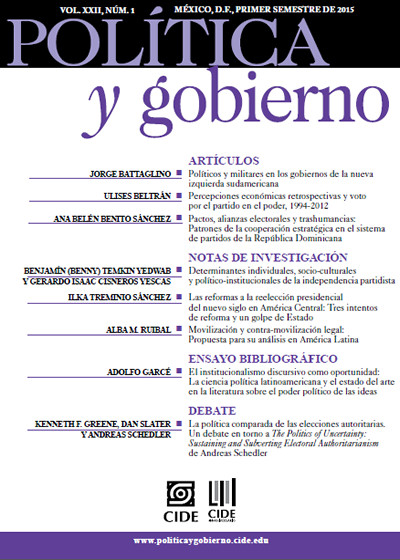
Discursive Institutionalism as an Opportunity: Latin American Political Science and the State of the Art on the Political power of Ideas
Keywords:
ideas, discourses, discursive institutionalism, Latin American political scienceAbstract
Ideas and discourses are back. During the last two decades, scholars frequently have argued that they are key variables in explaining political change. Despite his intense and well known “Americanization”, Latin American political science has not had a similar ideational turn. In this context, discursive institutionalism, the latest of the “new institutionalisms”, must play an important role.References
Abelson, D. E. (2006), A Capitol Idea: Think Tanks and U.S. Foreign Policy, Montreal y Kingston, McGill-Queen’s University Press.
Almond, G. (1988), “Separate Tables: Schools and Sects in Political Science”, Political Science and Politics, 21(4), pp. 828-842.
Altman, D. (2005), “La institucionalización de la ciencia política en Chile y América Latina: una mirada desde el sur”, Revista de Ciencia Política, 25(1), pp. 3-15.
Amorin Neto, O. y F. Santos (2005), “La ciencia política en Brasil: el desafío de la expansión”, Revista de Ciencia Política, 25(1), pp. 101-110.
Barrientos, F. (2009), “La ciencia política en América Latina. Apuntes para una historia (estructural e intelectual) de la disciplina en la región”, ponencia preparada para el Seminario de Investigación del Área de Ciencia Política y de la Administración de la Universidad de Salamanca.
(2013), “La ciencia política en América Latina. Una breve introducción histórica”, Convergencia, 20(6), pp. 105-133.
Bell, S. (2011), “Do We Really Need a New ‘Constructivist Institutionalism’ to Explain Institutional Change?”, British Journal of Political Science, 41, pp. 883-906.
Bevir, M. (2006), “How Narratives Explain”, en D. Yanow y P. Schwartz-Shea (eds.), Interpretation and Method: Empirical Research Methods and the Interpretive Turn, Armonk, Nueva York, M.E. Sharpe, pp. 281-290.
Blyth, M.( 2002), Great Transformations. Economic Ideas and Institutional Change in the Twentieth Century, Nueva York, Cambridge University Press.
Boix, C. (1996), Partidos políticos, crecimiento e igualdad, Madrid, Alianza.
Bulcourf, P. (2012), “El desarrollo de la ciencia política en Argentina”, Política, 50(1), pp. 59-92.
Bulcourf, P. y N. Cardoso (2014), “La ciencia política en América Latina: un análisis comparado de su desarrollo”, manuscrito.
Campbell, J.L. y O. Pedersen (2011), “Knowledge Regimes and Comparative Political Economy”, en D. Béland y R.H. Cox (ed.), Ideas and Politics in Social Science Research, Oxford, Oxford University Press, pp. 167-190.
Dolowitz, D. y D. Marsh (2000), “Learning from Abroad: The Role of Policy Transfer in Contemporary Policy-Making”, Governance,13(1), pp.5-24.
Fernández, M. de los A. (2005), “Ciencia política en Chile: un espejo intelectual”, Revista de Ciencia Política, 25(1), pp. 56-75.
Fernández, M. de los A. y C. Grebe (2010), “Ciencia política e historia disciplinar:modelo para armar”, Politeia, 44(33), pp. 1-30.
Goldstein Judith y Robert Keohane (eds.) (1993), Ideas and Foreign Policy: Beliefs, Institutions, and Political Change, Ithaca & NY, Cornell University Press.
Goodin, R. y H.D. Klingemann (1996), “Ciencia política: la disciplina”, en R, Goodin y H.D. Klingemann (eds.), Nuevo manual de Ciencia Política, t.I. Madrid, Istmo, pp. 21-82.
Goodin R. y H.D. Klingemann (2001), A New Handbook of Political Science, Oxford, Oxford University Press.
Haas, P. (1992), “Introduction: Epistemic Communities and International Policy Coordination”, International Organization, 46(1), pp. 1-35.
Hall, P.A. (ed.) (1989), The Political Power of Economic Ideas: Keynesianism Across Nations, Princeton, Princeton University Press.
Hall, P. (1993), “Policy Paradigms, Social Learning and the State: The Case of Economic Policymaking in Britain”, Comparative Politics, 25(3), pp. 275-296.
(1997), “The Role of Interests, Institutions, and Ideas in the Comparative Political Economy of the Industrialized Nations”, Lichbach, Mark y Alan Zuckerman, Comparative Politics: Rationality, Culture, and Structure, Cambridge, Cambridge University Press.
Hall, P.A. y R. Taylor (1996), “Political Science and the Three New Institutionalisms”, Political Studies, XLIV, pp. 936-957.
Hay, C. (2011), “Ideas and the Construction of Interests”, en D. Béland y R.H. Cox (eds), Ideas and Politics in Social Science Research, Nueva York, Oxford University Press, pp. 65-82.
Huneeus, C. (2006), “El lento y tardío desarrollo de la ciencia política en América Latina, 1966-2006”, en memoria de Gustavo Lagos, Estudios Internacionales, 155, pp. 137-156.
Landman, T. (2002), “Rebutting ‘Perestroika’: Method and Substance in Political Science”, manuscrito, Department of Government, Essex University. Disponible en. http://privatewww.essex.ac.uk/~todd/rebutting%20perestroika.pdf
Mainwaring, S. y A. Pérez-Liñán (2012), “Democratic Breakdown and Survival in Latin America, 1945-2005”, ponencia presentada en la Conferencia “Guillermo O’Donnell and the Study of Democracy”, Buenos Aires, 26 y 27 de marzo.
Mainwaring, S. y A. Pérez-Liñán (2013), Democracies and Dictatorships in Latin America: Emergence, Survival, and Fall, Cambridge, Cambridge University Press, en prensa.
Marsh, D. y J.C. Sharman (2009), “Policy Diffusion and Policy Transfer”, Policy Studies, 30(3), pp. 269-288.
McGann, J.G. (2013), 2012 Global Go To Think Tanks Report and Policy Advice, Filadelfia, University of Pennsylvania Press.
Mehta, J. (2011), “The Varied Roles of Ideas in Politics”, en D. Béland y R.H. Cox (eds), Ideas and Politics in Social Science Research, Nueva York, Oxford University Press, pp. 23-46.
Munck, G. (2007), “The Past and Present of Comparative Politics”, en G. Munck y R. Snyder, Passion, Craft and Method in Comparative Politics, Baltimore, The Johns Hopkins University Press, pp. 32-59.
Nahrath, S. (1999), “The Power of Ideas in Policy Research”, en D. Braun y A. Busch (eds.), Public Policy and Political Ideas, Cheltenham-Northampton, Edward Elgar.
Negretto, G. (2004), “El rumbo de la ciencia política”, Política y Gobierno, XI(2), pp. 355-359.
Panizza, F. y R. Miorelli (2012 en línea), “Taking Discourse Seriously: Discursive Institutionalism and Post-structuralist Discourse”, Political Studies, 2013, 61(2), pp. 301-318.
Ravecca, P. (2010), “La política de la ciencia política: ensayo de introspección disciplinar desde América Latina hoy”, Revista América Latina, 9, pp. 176-183.
Retamozo, M. (2009), “La ciencia política contemporánea: ¿constricción de la ciencia y aniquilamiento de lo político? Apuntes críticos para los estudios políticos en América Latina”, Andamios, 6(11), pp. 71-100.
Rocha, C. (2012), “La ciencia política en Uruguay (1989-2009): temas, teorías y metodologías”, Revista Uruguaya de Ciencia Política, 21(2), pp. 97-127.
Sabatier, P. y H. Jenkins-Smith (eds.) (1993), Policy Change and Learning: An Advocacy Coalition Approach, Boulder, Westview Press.
Sartori, G. (2004), “¿Hacia dónde va la ciencia política?”, Política y Gobierno, XI(2), pp. 349-354.
Schmidt, V.A. (2008), “Discursive Institutionalism: The Explanatory Power of Ideas and Discourse”, Annual Review of Political Science, 11, pp.303-326.
(2011), “Reconciling Ideas and Institutions through Discursive Institutionalism”, en D. Béland y R.H. Cox (eds). Ideas and Politics in Social Science Research, Nueva York, Oxford University Press, pp. 47-64.
Schmitter, P.C. (2002), “Seven (Disputable) Theses Concerning The Future of ‘Tranatlanticised’ or ‘Globalised’ Political Science”, European Political Science, 1(2), pp. 23-40.
Sikkink, K. (1991), Ideas and Institutions. Developmentalism in Brazil and Argentina, Ithaca, Cornell University Press.
Smith, R. (2006), “Which Comes First, the Ideas or the Institutions?”, en I. Shapiro, S. Skowronek y D. Galvin (eds.), Rethinking Political Institutions: The Art of the State, Nueva York, New York University Press, pp. 91-113.
Stone, D. y A. Denham (2004), Think Tank Traditions: Policy Research and the Politics of Ideas, Manchester, Manchester University Press.
Stone, D. y A. Denham (2004), Think Tanks Traditions. Public Research and the Politics of Ideas. Manchester y Nueva York, Manchester University Press.
Weyland, K. (2002), “The Diffusion of Innovations: A Theoretical Analysis”, ponencia para el panel de apsa sobre “Prospect Theory”, Boston, 29 de agosto al 1° de setiembre 2012.
(2005), “Theories of Policy Diffusion: Lessons from Latin America Pension Reform”, World Politics, 57(2), pp. 262-295.
(2006), Bounded Rationality and Policy Diffusion. Social Sector Reform in Latin America, Princeton y Oxford, Princeton University Press.
Downloads
Issue
Section
License
The authors who publish in this journal agree on the following conditions:
In accordance with copyright laws, Política y gobierno recognizes and respects the authors’ moral rights, as well as the ownership of property rights, which will be transferred to the journal for its dissemination in open access. Política y gobierno does not charge the authors for submitting and processing articles for publication.
All the articles published in Política y gobierno —with no exception— are distributed under a Creative Commons License 4.0 Attribution Non-Commercial (CC BY-NC 4.0 International), that allows third parties to use the published work providing they mention the authorship of the work and the first publication in this journal.
The authors can enter into other independent and additional contractual arrangements for the non-exclusive distribution of the version of the article published in Política y gobierno (for example to include it into an institutional repository or publish it in a book) as lomg as it is clearly indicated that the work was published for the first time in Política y gobierno.
For all of the above, the author(s) must submit the Format of transfer of the ownership of the first publishing rights duly filled in and signed by the author(s). This format can be sent as a pdf by e-mail: politicaygobierno@cide.edu (Letter- transfer of property rights)

This work is licensed under a Creative Commons Attribution-Noncommercial 4.0 International.






 Contact