
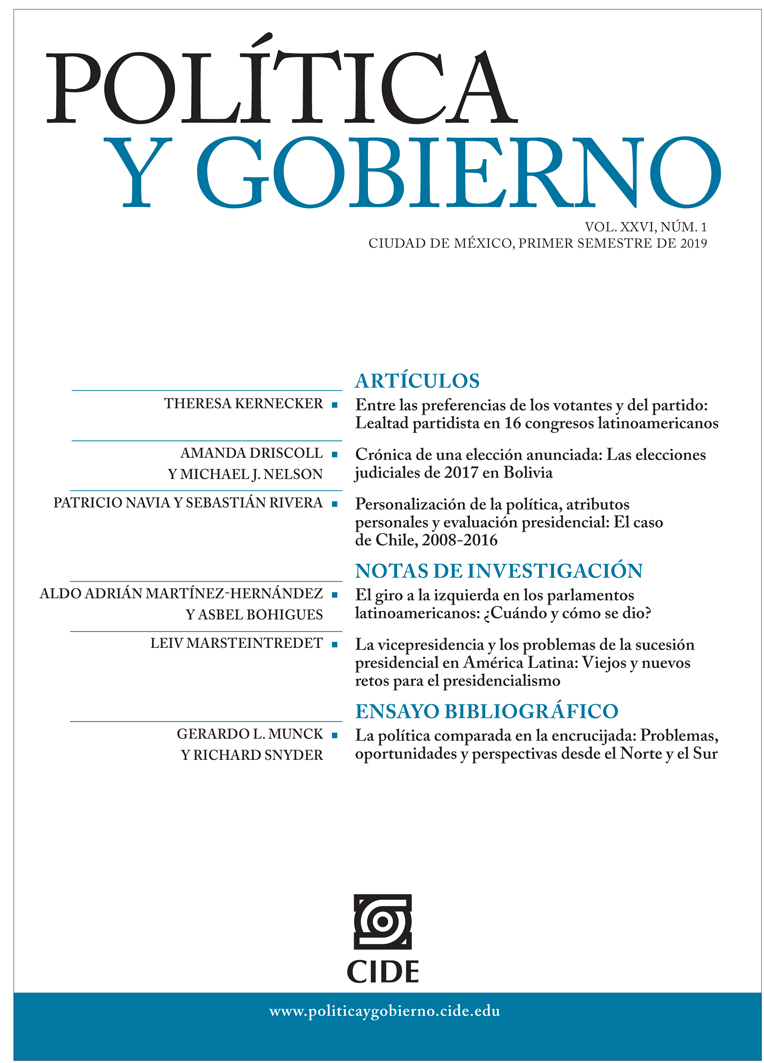
Crónica de una elección anunciada: Las elecciones judiciales de 2017 en Bolivia/Chronicle of an Election Foretold: The 2017 Bolivian Judicial Elections
Keywords:
elecciones judiciales, voto nulo, Bolivia, democraciaAbstract
El día 3 de diciembre de 2017, los electores bolivianos fueron a las urnas para votar directamente por sus jueces y magistrados nacionales. Bolivia es el único país en la historia del mundo moderno que utiliza elecciones para seleccionar a sus jueces de jurisdicción nacional, las elecciones de 2017 son las segundas de este tipo y han generado mucha polémica. Aquí informamos sobre esta elección y afirmamos que, aunque haya cumplido formalmente con la Constitución Plurinacional, el gobierno del Movimiento al Socialismo (MAS) limitó sistemáticamente la capacidad del pueblo boliviano de expresar su voluntad electoral. Los votantes registraron su descontento anulando más papeletas que en cualquier otra elección en la historia boliviana. Al analizar datos originales de una encuesta de opinión pública y los resultados electorales a nivel municipal, demostramos que la posición en la papeleta electoral explica más que las características o las calificaciones profesionales de los candidatos que ganaron, mientras que votar en blanco o anular el voto fue una expresión de insatisfacción con el proyecto político más amplio del MAS.
On December 3, 2017, Bolivian voters went to the polls to vote for their national judges. Bolivia is the only country in modern world history to use direct elections to select its judges, and the adoption and implementation of these elections has been highly contentious. We report on this election and contend that though formally compliant with the Bolivian Constitution, the MAS supermajority used its powers to limit the ability of the public to make its voice heard in an electorally meaningful way. Voters registered their discontent by spoiling more ballots than in any election in Bolivian history. Relying on original survey data as well as municipal-level election returns, we demonstrate that candidates’ electoral fates in this election were tied more closely to their position on the ballot than their ascriptive characteristics or professional qualifications, and voters’ decisions to cast spoiled votes correlate strongly with their dissatisfaction with the broader MAS political project.
Published
Issue
Section
License
The authors who publish in this journal agree on the following conditions:
In accordance with copyright laws, Política y gobierno recognizes and respects the authors’ moral rights, as well as the ownership of property rights, which will be transferred to the journal for its dissemination in open access. Política y gobierno does not charge the authors for submitting and processing articles for publication.
All the articles published in Política y gobierno —with no exception— are distributed under a Creative Commons License 4.0 Attribution Non-Commercial (CC BY-NC 4.0 International), that allows third parties to use the published work providing they mention the authorship of the work and the first publication in this journal.
The authors can enter into other independent and additional contractual arrangements for the non-exclusive distribution of the version of the article published in Política y gobierno (for example to include it into an institutional repository or publish it in a book) as lomg as it is clearly indicated that the work was published for the first time in Política y gobierno.
For all of the above, the author(s) must submit the Format of transfer of the ownership of the first publishing rights duly filled in and signed by the author(s). This format can be sent as a pdf by e-mail: politicaygobierno@cide.edu (Letter- transfer of property rights)

This work is licensed under a Creative Commons Attribution-Noncommercial 4.0 International.






 Contact