
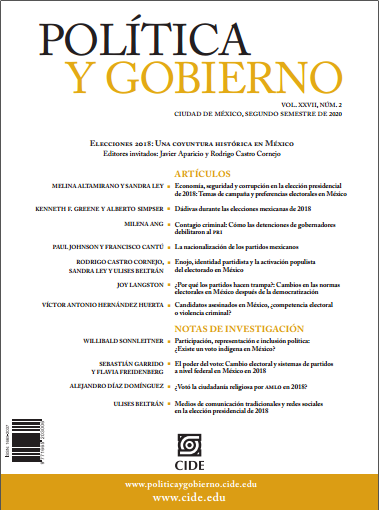
Candidates Murdered in Mexico: Criminal or Electoral violence?
Keywords:
elections, political assassinations, electoral violence, criminal organizationsAbstract
The 2018 electoral process in México was not only the largest electoral process in Mexico’s history by the number of positions to be filled, but also it was the most violent in recent history. Since the beginning of the electoral campaigns until the election day, 48 candidates were assassinated. What explains this unprecedented wave of political assassinations? Are they caused by a
close electoral competition or by criminal violence? By using an original database in which we recorded the number of candidates assassinated by municipality, we tested both competing theories and found that the killings are not related to competitive elections, but instead they are linked to
the presence of criminal organizations and to the level of criminal violence in each municipality. In some states, such as Puebla and Guerrero, statistical evidence also suggests that the murdered candidates were targeted by criminal organizations.
References
Aguirre, Jerjes y Hugo Herrera (2013), “Institutional weakness and organized crime in Mexico: the case of Michoacán”, Trends in Organized Crime, 16 (2), pp. 221–38. https://doi.org/10.1007/s12117-013-9197-1.
Albarracín, Juan (2018), “Criminalized Electoral Politics in Brazilian Urban Peripheries”, Crime, Law and Social Change, 69 (4), pp. 553–75. https://doi.org/10.1007/s10611-017-9761-8.
Alesina, Alberto, Salvatore Piccolo y Paolo Pinotti (2016), “Organized Crime, Violence, and Politics”, Working Paper 22093, National Bureau of Economic Research. https://doi.org/10.3386/w22093.
Alonso López, Daniel Felipe (2015), “Violencia Política” En: Mapas y factores de riesgo electoral. Elecciones de autoridades locales, Colombia, 2015, Bogotá, Colombia: Misión de Observación Electoral, disponible en: https://moe.org.co/wp-content/uploads/2017/07/Mapas_de_Riesgo_Electoral_MOE_Elecciones_Autoridades_Locales_2015.pdf [fecha de consulta: 15 de noviembre de 2018].
Birch, Sarah (2011), Electoral malpractice, New York: Oxford University Press.
Blume, Laura Ross (2017), “The Old Rules No Longer Apply: Explaining Narco-Assassinations of Mexican Politicians”, Journal of Politics in Latin America, 9 (1), pp. 59–90.
Chavez, Héctor (2018), “Morir por estar en la boleta”, Animal Político, disponible en: https://www.animalpolitico.com/blogueros-el-foco/2018/06/28/morir-por-estar-en-la-boleta-los-candidatos-asesinados-en-mexico/ [fecha de consulta: 28 de junio de 2018].
Coscia, Michelle y Viridiana Rios (2012), “Knowing Where and How Criminal Organizations Operate Using Web Content”, In CIKM’12, ACM International Conference on Information and Knowledge Management, Maui, Hawaii, disponible en: https://scholar.harvard.edu/files/vrios/files/cosciarios2012_wherehowcriminalsoperate.pdf [fecha de consulta: 7 de agosto de 2018].
Cubaque Barrera, Catalina (2011), “Violencia política, elecciones locales 2011.” En: Mapas y Factores de Riesgo Electoral, Bogotá, Colombia: Misión de Observación Electoral. disponible en: https://moe.org.co/wp-content/uploads/2017/07/Libro_MOE_Mapas_y_factores_de_riesgo_electoral_2011-4.pdf [fecha de consulta: 15 de noviembre de 2018].
Dal Bó, Ernesto, Pedro Dal Bó y Rafael Di Tella (2006), “‘Plata o Plomo?’: Bribe and Punishment in a Theory of Political Influence”, American Political Science Review, 100 (1), pp. 41–53. https://doi.org/10.1017/S0003055406061995.
Daniele, Gianmarco y Gemma Dipoppa (2017), “Mafia, elections and violence against politicians”, Journal of Public Economics, 154 (octubre), pp. 10–33. https://doi.org/10.1016/j.jpubeco.2017.08.004.
El Universal (2018), “Entérate. ¿Quiénes son los candidatos asesinados durante el proceso electoral?”, El Universal, disponible en: http://www.eluniversal.com.mx/elecciones-2018/enterate-quienes-son-los-candidatos-asesinados-durante-el-proceso-electoral [fecha de consulta: 25 de junio de 2018].
Firth, David (1993), “Bias Reduction of Maximum Likelihood Estimates”, Biometrika, 80 (1), pp. 27–38. https://doi.org/10.1093/biomet/80.1.27.
Freidenberg, Flavia y Raymundo Alva Huitrón (2017), “¡Las reglas importan! Impulsando la representación política de las mujeres dese las leyes electorales en perspectiva multinivel”, en Flavia Freidenberg (ed.), La representación política de las mujeres en México, México, INE e IIJ-UNAM, pp. 1-44.
García-Sánchez, Miguel (2016), “Control territorial y decisión de voto en Colombia Un enfoque multinivel / Territorial control and vote choice in Colombia A multilevel approach”, Política y gobierno, 23 (1), pp. 53-96.
Hafner-Burton, Emilie M., Susan D. Hyde y Ryan S. Jablonski (2014), “When Do Governments Resort to Election Violence?”, British Journal of Political Science, 44 (1), pp. 149–79. https://doi.org/10.1017/S0007123412000671.
Höglund, Kristine (2009), “Electoral Violence in Conflict-Ridden Societies: Concepts, Causes, and Consequences”, Terrorism and Political Violence, 21(3), pp. 412–27. https://doi.org/10.1080/09546550902950290.
King, Gary y Langche Zeng (2001), “Logistic Regression in Rare Events Data”, Political Analysis, 9 (2), pp. 137–63. https://doi.org/10.1093/oxfordjournals.pan.a004868.
Ley, Sandra (2018), “To Vote or Not to Vote: How Criminal Violence Shapes Electoral Participation”, Journal of Conflict Resolution, 62 (9), pp. 1963-1990. https://doi.org/10.1177/0022002717708600.
Misión de Observación Electoral (2018), Informe general de observación. Elecciones de Congreso y consultas populares interpartidistas, Bogotá, Colombia: Misión de Observación Electoral, disponible en: https://moe.org.co/wp-content/uploads/2018/11/Informe-de-Observaci%C3%B3n-Elecciones-de-Congreso_Digital.pdf [fecha de consulta: 15 de noviembre de 2018].
O’Donnell, Guillermo (2004), “Why the Rule of Law Matters”, Journal of Democracy, 15 (4), pp. 32–46.
Osorio, Javier (2015), “The Contagion of Drug Violence: Spatiotemporal Dynamics of the Mexican War on Drugs”, Journal of Conflict Resolution, 59 (8), pp. 1403–32. https://doi.org/10.1177/0022002715587048.
Perliger, Arie (2015), “The Rationale of Political Assassinations”, The Combating Terrorism Center at West Point, disponible en: https://www.hsdl.org/?abstract&did=762221 [fecha de consulta: 12 de julio de 2018].
Ponce, Aldo F (2018), “Violence and Electoral Competition: Criminal Organizations and Municipal Candidates in Mexico”, Trends in Organized Crime, mayo, pp. 1–24. https://doi.org/10.1007/s12117-018-9344-9.
Salazar Vázquez, Rubén (2018), “Séptimo Informe de Violencia Política en México 2018”, Etellekt Consultores, el 9 de julio de 2018.
Torgler, Benno, y Bruno S. Frey (2013), “Politicians: be killed or survive”, Public Choice, 156 (1/2), pp. 357–86. DOI 10.1007/s11127-011-9908-6.
Trejo, Guillermo, y Sandra Ley (2018), “Why Did Drug Cartels Go to War in Mexico? Subnational Party Alternation, the Breakdown of Criminal Protection, and the Onset of Large-Scale Violence”, Comparative Political Studies, 51 (7), pp. 900–937. https://doi.org/10.1177/0010414017720703.
Trelles, Alejandro, y Miguel Carreras (2012), “Bullets and Votes: Violence and Electoral Participation in Mexico”, Journal of Politics in Latin America, 4 (2), pp. 89–123.
Downloads
Published
Issue
Section
License
The authors who publish in this journal agree on the following conditions:
In accordance with copyright laws, Política y gobierno recognizes and respects the authors’ moral rights, as well as the ownership of property rights, which will be transferred to the journal for its dissemination in open access. Política y gobierno does not charge the authors for submitting and processing articles for publication.
All the articles published in Política y gobierno —with no exception— are distributed under a Creative Commons License 4.0 Attribution Non-Commercial (CC BY-NC 4.0 International), that allows third parties to use the published work providing they mention the authorship of the work and the first publication in this journal.
The authors can enter into other independent and additional contractual arrangements for the non-exclusive distribution of the version of the article published in Política y gobierno (for example to include it into an institutional repository or publish it in a book) as lomg as it is clearly indicated that the work was published for the first time in Política y gobierno.
For all of the above, the author(s) must submit the Format of transfer of the ownership of the first publishing rights duly filled in and signed by the author(s). This format can be sent as a pdf by e-mail: politicaygobierno@cide.edu (Letter- transfer of property rights)

This work is licensed under a Creative Commons Attribution-Noncommercial 4.0 International.






 Contact