
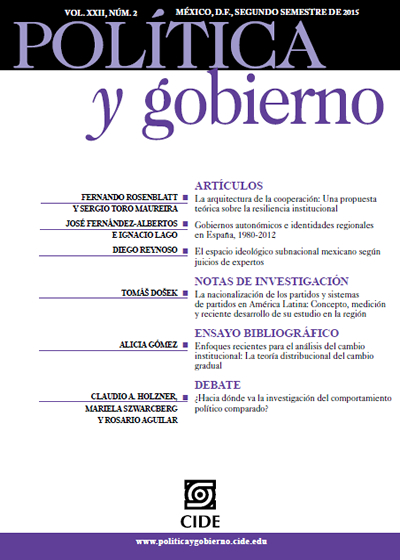
The Architecture of Cooperation: A Theoretical Proposal about Institutional Resilience
Keywords:
institutions, resilience, cooperationAbstract
In Latin America, institutions are either fragile or excessively strong. These are the main conclusions that can be inferred by looking at the institutionalist literature that focuses in the region. Although there are numerous studies about the effects of both traits, there are few analyses about the determinants that explain such results. Taking advantage of this theoretical vacuum, this paper introduces an analytical typology that build upon historical and rational choice institutionalism. We argue that to have better assessments of institutional stability and resilience it is critical to focus on the range and timing of the agreements reached by the agents involved in the institutional design. We claim that this focus will help understand institutional stability and instability as well as their degree of legitimacyReferences
Bates, R. (2008), When Things Fell Apart, Nueva York, Cambridge University Press.
Bates, Robert, Avner Greif, Margaret Levi y Jean-Laurent Rosenthal (1998), Analytic Narratives, Princeton, Princeton University Press.
Boyland, Delia M. (1998), “Preemptive Strike: Central Bank Reform in Chile’s Transition from Authoritarian Rule”, Comparative Politics, 30(4), pp. 443-462.
(2009), “Preemptive Strike Central Bank Reform in Chile’s Transition from Authoritarian”, Comparative Politics, 30(4), 443-462.
Collier, D. y R.B. Collier (2002), Shaping the Political Arena: Critical Junctures, the Labor Movement and Regime Dynamics in Latin America, Indiana, Notre Dame University Press.
Coppedge, M. (1994), Strong Parties and Lame Ducks: Presidential Partyarchy and Factionalism in Venezuela, Stanford, Stanford University Press.
Duverger, M. (1966), Political Parties: Their Organization and Activity in the Modern State, 2a. ed., Nueva York, Wiley.
Elkins, Z. y J. Sides (2007), “Can Institutions Build Unity in Multiethnic States?”, American Political Science Review, 101(4), pp. 693-708, disponible en: http://journals.cambridge.org/abstract_S0003055407070505
Elkins, Z., T. Ginsburg y J. Melton (2009), The Endurance of National Constitutions, Nueva York, Cambridge University Press.
Gerring, J. y S. Thacker (2008), A Centripetal Theory of Democratic Governance, Nueva York, Cambridge University Press.
Ginsburg, T. y Z. Elkins (2009), “Public Choice and Constitutional Design”, University of Chicago Law & Economics, Olin Working Paper núm. 451.
González Videla, G. y O. Frodden Lorenzen (1948), “Cartas cambiadas entre el serenísimo gran maestro y S.E. el presidente de la República, don Gabriel Gonzalez Videla”, Santiago de Chile.
Greif, A. y D.D. Laitin (2004), “A Theory of Endogenous Institutional Change”, American Political Science Review, 98(04), doi:10.1017/S0003055404041395.
Haggard, S. y M. McCubbins (2001), Presidents, Parliaments and Policy, Nueva York, Cambridge University Press.
Haindl, E. (2007), Chile y su desarrollo económico en el siglo xx, Santiago de Chile, Editorial Andrés Bello.
Hall, P. y R. Taylor (1996), “Political Science and the Three New Institutionalisms”, Political Studies, 44(5), pp. 936-957.
Helmke, G. y S. Levitsky (2004), “Informal Institutions and Comparative Politics: A Research Agenda”, Perspectives on Politics, 2(4), pp. 725-740.
Huntington, S. (1968), Political Order in Changing Societies, Yale, Yale University Press.
Katznelson, I. y B. Weingast (2005), “Intersections between Historical and Rational Choice Institutionalism”, en I. Katznelson y B. Weingast (eds.), Preferences and Situations: Points of Intersection between Historical and Rational Choice Institutionalism, Nueva York, Russell Sage.
Linz, J. (1978), The Breakdown of Democratic Regimes: Crisis, Breakdown and Reequilibration, Baltimore, Johns Hopkins University Press.
Mahoney, J. y K. Thelen (2010), “A Theory of Gradual Institutional Change”, en J. Mahoney y K. Thelen (eds.), Explaining Institutional Change:Ambiguity, Agency, and Power, pp. 1-37, Cambridge, Cambridge University Press.
March, James G. y Johan P. Olsen (1984), “The New Institutionalism: Organizational Factors in Political Life”, American Political Science Review, 78 (septiembre), pp. 734-749.
Marfán, M. (1984), Políticas reactivadoras y recesión externa: Chile 1929-1938, Santiago de Chile, Cieplan, 12.
McGuire, J.W. (1997), Peronism without Perón: Unions, Parties and Democracy in Argentina, Stanford, Stanford University Press.
Meller, P. (1996), Un siglo de economía política chilena (1890-1990), Santiago de Chile, Editorial Andrés Bello.
Moulian, T. (1973), Desarrollo político y estado de compromiso: Desajustes y crisis estatal en Chile, Santiago de Chile, Corporación de Investigaciones Económicas para Latinoamérica.
Mustapic, A.M. (2002), “Oscillating Relations: President and Congress in Argentina”, en S. Morgenstern y B. Nacif (eds.), Legislative Politics in Latin America, Cambridge, Cambridge University Press, pp. 23-47.
North, D. (1990), Institutions, Institutional Change and Economic Performance (Political Economy of Institutions and Decisions), Cambridge, Cambridge University Press.
North, D., J.J. Wallis y B.R. Weingast (2009), Violence and Social Orders: A Conceptual Framework for Interpreting Recorded Human History, Nueva York, Cambridge University Press.
Olson, M. (1971), The Logic of Collective Action: Public Goods and the Theory of Groups, Cambridge, Harvard University Press.
Palermo, V. y M. Novaro (1996), Política y poder en el gobierno de Menem, Buenos Aires, Norma.
Pierson, P. (2004), Politics in Time: History, Institutions and Social Analysis, Princeton, Princeton University Press.
Piñeiro, R. (2014), “Cartelización clientelar y estabilidad de la democracia en América Latina pre 1974”, tesis doctoral, Pontificia Universidad Católica de Chile, Instituto de Ciencia Política.
Przeworski, A. (2010), Democracy and the Limits of Self-Government, Nueva York, Cambridge University Press.
Reyes Álvarez, J. (1989), “Los presidentes radicales y su partido: Chile 1938-1952”, Centro de Estudios Públicos, 35, pp. 71-101.
Rosenblatt, F. (2006), “El dispar desenlace de la crisis económica en Argentina y Uruguay (2001-2002): Una explicación desde la teoría de las prospectivas”, Revista de Ciencia Política, 26(2), pp. 97-119.
Rovira Mas, J. (ed.) (2001), La democracia de Costa Rica ante el siglo xxi, San José, Editorial de la Universidad de Costa Rica.
Thelen, K. (2003), “How Institutions Evolve: Insights from Comparativae Historical Analysis”, en J. Mahoney y D. Rueschemeyer (eds.), Comparative Historical Analysis in the Social Sciences, Nueva York, Cambridge
University Press, pp. 208-240.
Valenzuela, A. y S. Valenzuela (1983), “Los orígenes de la democracia: Reflexiones teóricas sobre el caso de Chile”, Estudios Publicos, 12, pp. 7-39.
Downloads
Issue
Section
License
The authors who publish in this journal agree on the following conditions:
In accordance with copyright laws, Política y gobierno recognizes and respects the authors’ moral rights, as well as the ownership of property rights, which will be transferred to the journal for its dissemination in open access. Política y gobierno does not charge the authors for submitting and processing articles for publication.
All the articles published in Política y gobierno —with no exception— are distributed under a Creative Commons License 4.0 Attribution Non-Commercial (CC BY-NC 4.0 International), that allows third parties to use the published work providing they mention the authorship of the work and the first publication in this journal.
The authors can enter into other independent and additional contractual arrangements for the non-exclusive distribution of the version of the article published in Política y gobierno (for example to include it into an institutional repository or publish it in a book) as lomg as it is clearly indicated that the work was published for the first time in Política y gobierno.
For all of the above, the author(s) must submit the Format of transfer of the ownership of the first publishing rights duly filled in and signed by the author(s). This format can be sent as a pdf by e-mail: politicaygobierno@cide.edu (Letter- transfer of property rights)

This work is licensed under a Creative Commons Attribution-Noncommercial 4.0 International.






 Contact