
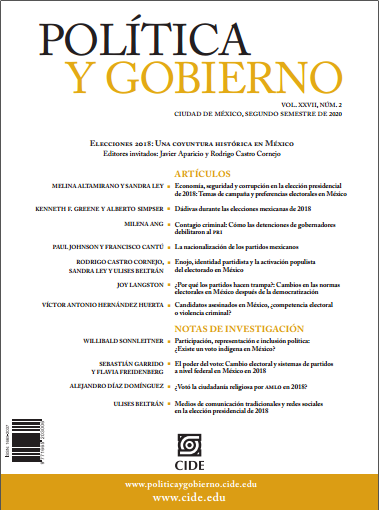
Anger, Partisanship, and the Activation of Populist Attitudes in Mexico
Keywords:
populism, partisanship, elections, Mexico, campaignsAbstract
This article analyzes the populist activation of the electorate during the 2018 presidential election in Mexico, which requires a set of conditions. First, voters need to report grievances about the country’s political, economic, and social situation. Moreover, it is necessary the role of ambitious politicians to make those grievances salient among voters, in order for voters to be responsive
to candidate’s populist rhetoric and translate their anger into electoral behavior. However, as opposed to previous studies, we argue that not every voter will be mobilized as a response to populist rhetoric, even if they register the same level of populist attitudes. Consistent with the political behavior literature, we argue that voters’ party identifcation constitutes a flter of information that makes co-partisan voters more likely to accept the populist rhetoric when it is consistent with their political predispositions. In other words, if the populist rhetoric contradicts voters’ partisanship, voters will reject the candidate’s populist rhetoric even though those voters report a high level of populist attitudes.
References
Aguilar, Rosario y Ryan E. Carlin. 2017. “Ideational Populism in Chile? A Case Study.” Swiss Political Science Review 23.4 (2017): 404-422.
Barr, Robert R. 2009. “Populists, outsiders and anti-establishment politics.” Party Politics 15(1): 29-48.
Cardoso, Fernando Henrique y Enzo Faletto. 1979. Dependency and development in Latin America (Dependencia y desarrollo en América Latina, engl.). University of California Press, 1979.
Dornbusch, Rudiger, and Sebastian Edwards. 1991. “The macroeconomics of populism.” The macroeconomics of populism in Latin America. University of Chicago Press, 1991. 7-13.
Doyle, David. 2011. “The legitimacy of political institutions: Explaining contemporary populism in Latin America.” Comparative Political Studies 44(11): 1447-1473.
Hawkins, Kirk A. 2009. “Is Chávez populist? Measuring populist discourse in comparative perspective.” Comparative Political Studies 42(8): 1040-1067.
Hawkins, Kirk A. y Cristóbal Rovira Kaltwasser. 2017. “The ideational approach to populism.” Latin American Research Review 52(4): 513-528.
Hawkins, Kirk A., Cristóbal Rovira Kaltwasser y Ioannis Andreadis. 2018. “The activation of populist attitudes.” Government and Opposition (2018): 1-25.
Jagers, Jan y Stefaan Walgrave. 2007. “Populism as political communication style: An empirical study of political parties' discourse in Belgium.” European Journal of Political Research 46(3): 319-345.
Meléndez, Carlos y Cristóbal Rovira Kaltwasser. 2017. “Political identities: The missing link in the study of populism.” Party Politics https://doi.org/10.1177/1354068817741287
Oxhorn, Philip. 1998. “The social foundations of Latin America’s recurrent populism: Problems of popular sector class formation and collective action.” Journal of Historical Sociology 11(2): 212-246.
Rico, Guillem, Marc Guinjoan y Eva Anduiza. 2017. “The emotional underpinnings of populism: how anger and fear affect populist attitudes.” Swiss Political Science Review 23(4): 444-461.
Rooduijn, Matthijs y Teun Pauwels. 2011. “Measuring populism: Comparing two methods of content analysis." West European Politics 34(6): 1272-1283.
Rooduijn, Matthijs. 2014. “The mesmerising message: The diffusion of populism in public debates in Western European media.” Political Studies 62(4): 726-744.
Rooduijn, Matthijs, Sarah L. De Lange y Wouter Van der Brug. 2014. “A populist Zeitgeist? Programmatic contagion by populist parties in Western Europe.” Party politics 20(4): 563-575.
Rico et al 2017
Spruyt, Bram, Gil Keppens y Filip Van Droogenbroeck. 2016. “Who supports populism and what attracts people to it?” Political Research Quarterly 69(2): 335-346.
Tsatsanis, Emmanouil, Ioannis Andreadis y Eftichia Teperoglou. 2018. “Populism from Below: Socio-economic and Ideological Correlates of Mass Attitudes in Greece.” South European Society and Politics DOI: 10.1080/13608746.2018.1510635
Valentino, Nicholas A., Ted Brader, Eric W. Groenendyk, Krysha Gregorowicz y Vincent L. Hutchings. 2011. “Election night’s alright for fighting: The role of emotions in political participation.” Journal of Politics 73(1): 156-170.
Vilas, Carlos M. 1992. “Latin American populism: A structural approach.” Science & Society 56(4): 389-420.
Weyland, Kurt. 2001. “Clarifying a Contested Concept: Populism in the Study of Latin American Politics.” Comparative Politics 34(1): 1-22.
Weyland, Kurt. 2017. “A Political-Strategic Approach.” In Cristobal Rovira Kaltwasser, Paul A. Taggart, Paulina Ochoa Espejo y Pierre Ostiguy (eds.). The Oxford Handbook of Populism. Oxford: Oxford University Press.
Downloads
Published
Issue
Section
License
The authors who publish in this journal agree on the following conditions:
In accordance with copyright laws, Política y gobierno recognizes and respects the authors’ moral rights, as well as the ownership of property rights, which will be transferred to the journal for its dissemination in open access. Política y gobierno does not charge the authors for submitting and processing articles for publication.
All the articles published in Política y gobierno —with no exception— are distributed under a Creative Commons License 4.0 Attribution Non-Commercial (CC BY-NC 4.0 International), that allows third parties to use the published work providing they mention the authorship of the work and the first publication in this journal.
The authors can enter into other independent and additional contractual arrangements for the non-exclusive distribution of the version of the article published in Política y gobierno (for example to include it into an institutional repository or publish it in a book) as lomg as it is clearly indicated that the work was published for the first time in Política y gobierno.
For all of the above, the author(s) must submit the Format of transfer of the ownership of the first publishing rights duly filled in and signed by the author(s). This format can be sent as a pdf by e-mail: politicaygobierno@cide.edu (Letter- transfer of property rights)

This work is licensed under a Creative Commons Attribution-Noncommercial 4.0 International.






 Contact